
For most businesses, electricity is something that gets used throughout the day and paid for at the end of the month. You might review your energy contract, compare suppliers or negotiate a better rate but beyond that, there often seems little opportunity to influence what you spend.
What if the biggest opportunity isn’t necessarily buying electricity more cheaply but changing when you buy it, how much you take from the grid and how effectively you use the electricity you already have? That’s where battery storage and intelligent energy management are changing the picture.
As electricity costs continue to rise and the UK energy system becomes increasingly reliant on renewable generation, businesses are beginning to recognise that simply consuming electricity is no longer the only option.
With the right infrastructure, it’s possible to store electricity when it’s cheaper or more readily available, use it when prices are higher, reduce demand from the grid during peak periods and potentially generate additional income by making flexible energy capacity available to the wider network. For larger commercial and industrial businesses, this presents an opportunity to turn energy management into something much more strategic.
Understanding the Real Cost of Your Electricity
As we’ve discussed in our previous article, Why UK Business Electricity Bills Keep Rising, the cost of electricity is about much more than the wholesale price of the energy itself.
A significant proportion of commercial electricity bills is made up of non-commodity costs, including network charges, transmission costs, environmental levies and other system-related expenses. Some of these charges are fixed, while others are influenced by how much electricity a business imports, when it uses it and the capacity it requires from the network.
Businesses may have limited influence over many of the charges applied to their electricity bills but they do have more control over their consumption patterns than they perhaps realise. For example, a manufacturing facility that draws a substantial amount of electricity during a short period of particularly high demand may face a different cost profile from a business that spreads its consumption more evenly throughout the day. Similarly, a warehouse that imports electricity during expensive peak periods may be paying considerably more than necessary if some of that demand could be met using stored electricity.
The opportunity, therefore, isn’t simply to reduce consumption. It’s to manage it more intelligently.
What Is Battery Storage and How Does It Work?
At its simplest, a commercial battery storage system allows a business to store electricity and use it at a later time. Electricity can be stored from several sources, including:
- Surplus electricity generated by onsite solar panels.
- Electricity purchased from the grid during cheaper periods.
- Electricity generated by other onsite sources, where appropriate.
The stored electricity can then be used when the building needs it, reducing the amount that has to be purchased from the grid however the real value comes from how the battery is managed.
Modern battery systems can be connected to intelligent energy management software that monitors electricity consumption, generation, tariffs and demand patterns. The system can then determine when it makes most commercial sense to charge or discharge the battery. Rather than simply storing electricity and waiting for it to be needed, the system can actively manage when energy is imported, stored and consumed.
For businesses with significant electricity requirements, this can open up several opportunities to reduce costs and potentially create additional revenue.
Peak Shaving: Reducing the Cost of Your Highest Demand
One of the most interesting applications of commercial battery storage is something known as peak shaving. The principle is relatively straightforward. Most businesses don’t consume electricity at a perfectly consistent rate. Demand fluctuates throughout the day depending on operational activity, machinery, lighting, heating, cooling and other equipment. A manufacturing facility, for example, might experience a significant increase in demand when several production lines, compressors and other electrical equipment are operating simultaneously. Rather than drawing all that electricity from the grid, a battery can discharge stored energy to help meet the additional demand and this reduces the amount of electricity being imported at that particular moment.
Why does that matter? Because some electricity network charges are influenced by demand, capacity or the time at which electricity is imported. Reducing peaks can therefore help businesses manage certain demand-related charges and, in some circumstances, avoid exceeding agreed import capacity. It may also help businesses avoid the need for costly increases in their grid connection capacity when expanding operations, although this depends on the site’s electrical requirements and DNO arrangements.
It’s important to understand that batteries don’t eliminate fixed network charges and the potential savings depend on the site’s tariff and charging structure.
In simple terms, instead of paying to import large amounts of electricity during short periods of high demand, you use electricity you’ve already stored.
Buying Electricity When It’s Cheaper and Using It When It’s Not
Another benefit of battery storage is the ability to take advantage of differences in electricity prices throughout the day. Many commercial energy contracts include time-of-use pricing, where electricity costs vary depending on the time of consumption.
Prices may be lower overnight or during periods of high renewable generation, while certain daytime and evening periods can be considerably more expensive and a battery can take advantage of these differences. It can be charged when electricity is cheaper and then discharged when prices increase, reducing the amount of electricity that needs to be purchased at the higher rate.
The same principle applies when a business has its own solar installation. Rather than exporting surplus generation during the day and buying electricity back later, a battery can store some of that electricity for use when solar generation falls.
The financial benefit depends on the difference between charging and discharging costs, including battery efficiency losses, network charges and the relevant tariff arrangements. This is why understanding a site’s actual consumption profile is essential. A battery should be designed around the way a business operates, rather than simply its total annual electricity consumption.
Energy Flexibility: Could Your Business Actually Get Paid for Managing Its Electricity?
This is where things become particularly interesting. The UK electricity network needs to balance supply and demand continuously. Electricity cannot simply be generated in unlimited quantities and left unused, generation and consumption need to be kept in balance.
Solar and wind generation are naturally variable. There may be periods when renewable electricity is plentiful and other times when the system needs additional support. As a result, the National Energy System Operator (NESO) is increasingly looking to businesses and other electricity consumers to play a more active role in managing demand. This is known as demand-side flexibility. Rather than simply consuming electricity whenever it is required, businesses with suitable infrastructure can be rewarded for changing when they use it.
For example, a business might be able to:
- Reduce electricity imports during periods when the grid is under pressure.
- Use stored battery electricity instead of importing power during expensive periods.
- Increase electricity consumption when renewable generation is abundant and the network needs additional demand.
- Make battery capacity available to support the wider electricity system.
These activities can potentially create financial rewards, either through direct participation in flexibility services or by working with an energy supplier or specialist aggregator.
The Demand Flexibility Service Is Evolving
One particularly relevant development is NESO’s Demand Flexibility Service (DFS). Originally introduced to help manage periods of high electricity demand during winter, the service has evolved considerably.
In April 2026, NESO expanded the service to introduce bi-directional flexibility, meaning participating businesses can potentially be rewarded not only for reducing or shifting electricity consumption but also for increasing consumption when there is an excess supply of electricity. It means flexibility is no longer simply about switching equipment off when the grid is under pressure. It is also about being able to use electricity at the times when it is most beneficial to the wider system. For businesses with battery storage, solar generation and suitable energy management systems, this creates further opportunities to explore.
The eligibility threshold was also reduced to 0.1MW, opening participation to a wider range of commercial sites and aggregated portfolios. Importantly, participation and financial rewards aren’t automatic and businesses generally need to access the relevant services through an eligible supplier, aggregator or other market participant, and the system must meet the applicable technical and operational requirements. Nevertheless, the direction of travel is clear, businesses that can manage their electricity consumption flexibly are becoming increasingly valuable to the energy system.
Revenue Stacking: Making Your Battery Work Harder
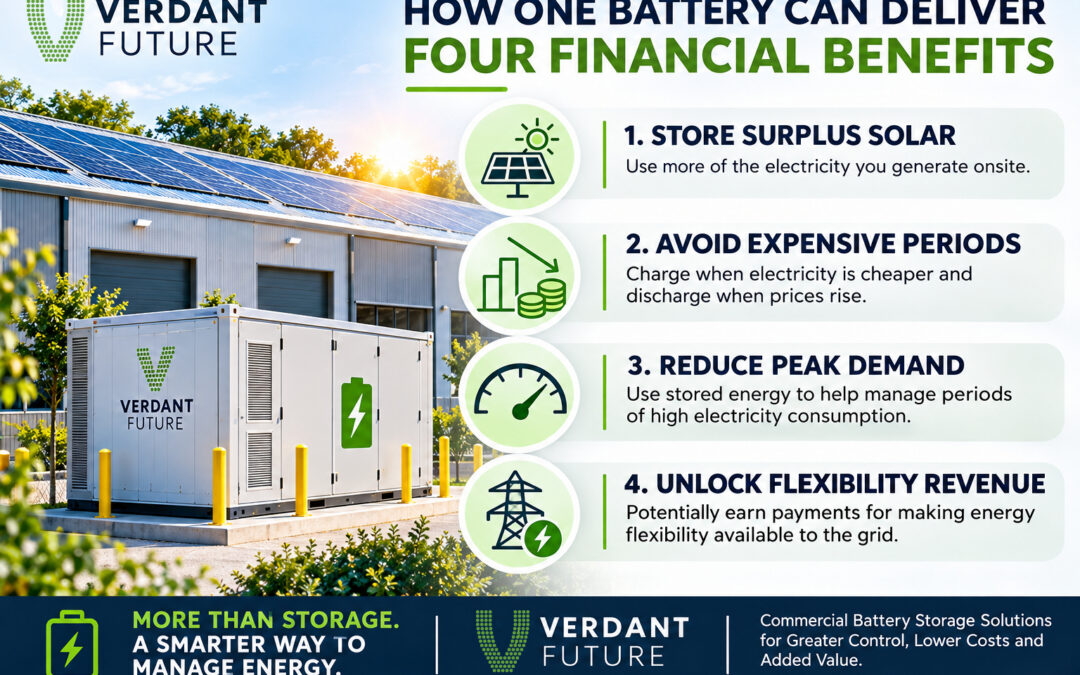
One of the most attractive aspects of commercial battery storage is that it doesn’t necessarily have to deliver just one financial benefit. This is often referred to as revenue stacking. In simple terms, it means using the same battery to deliver several different financial benefits, rather than relying on one particular saving or revenue stream.
For example, a suitably configured battery could potentially:
- Store surplus solar electricity to reduce imported electricity.
- Charge during cheaper tariff periods and discharge when prices are higher.
- Reduce peak demand and help manage certain network charges.
- Participate in eligible flexibility services and receive payments for supporting the grid.
The idea is to maximise the value of the battery throughout the day rather than allowing it to sit idle when it could be doing something commercially useful however, there is an important distinction between theoretical and achievable returns. A battery cannot necessarily participate in every available service simultaneously, some activities compete for the same stored capacity, while others have specific availability, response and operational requirements. The system needs to be carefully designed and managed to balance these opportunities without compromising the business’s own electricity requirements. For larger commercial and industrial sites, getting this right can make a considerable difference to the overall financial case for investment.
Is Commercial Battery Storage Worth the Investment?
This is probably the question most business owners and finance directors will want answered and understandably so.
Commercial battery storage represents a significant capital investment, so the financial case needs to stack up. The potential return will depend on several factors, including:
- The site’s annual and half-hourly electricity consumption.
- The shape of its demand profile and peak usage.
- Its electricity tariff and import arrangements.
- Whether onsite solar generation is available.
- The size and configuration of the battery.
- The available opportunities to participate in flexibility markets.
- Installation, maintenance and operating costs.
For some businesses, the greatest benefit may come from storing surplus solar electricity. For others, reducing peak demand or taking advantage of time-of-use tariffs may provide a stronger financial incentive. Larger energy users may also have opportunities to combine several benefits. The important thing is not to start with the battery itself, but with the electricity data. By analysing actual consumption patterns, it becomes possible to model when a battery would charge, when it would discharge, how much grid electricity it could displace and what additional flexibility opportunities may be available. This provides a much more realistic picture of the potential return than simply looking at the battery’s capacity or headline price.
Your Business Doesn’t Have to Become an Energy Expert
One of the challenges with commercial battery storage is that the technology is only part of the equation. Understanding tariffs, network charges, electricity markets, DNO requirements and flexibility services can quickly become complicated.
For many businesses, managing all of this internally simply isn’t practical that’s why having the right energy partner is important.
At Verdant Future, we look at the wider energy requirements of a business before recommending a solution. Our approach considers how much electricity you use, when you use it, how much you could potentially generate onsite and whether battery storage could deliver meaningful financial benefits. We provide a fully managed service covering:
- Energy consumption analysis and feasibility studies.
- Commercial solar and battery system design.
- Battery sizing and financial modelling.
- Peak demand and energy management opportunities.
- Planning applications where required.
- DNO applications and grid connection requirements.
- G99 applications and technical approvals where applicable.
- Installation and commissioning
- Ongoing monitoring and maintenance
We also understand that commercial energy projects involve more than simply installing equipment. They require coordination across several technical and regulatory stages. By managing the process from beginning to end, we give clients one point of contact and a single coordinated approach, helping to simplify what can otherwise become a complicated project.
At Verdant Future, we help commercial and industrial businesses understand their opportunities and turn them into practical, commercially viable solutions.
Your electricity bill may be largely outside your control but how much electricity you buy, when you use it and how effectively you manage it is a different matter.
If your business has significant electricity consumption, now is a good time to explore what commercial battery storage could do for you.
Get in touch with Verdant Future to discuss your energy requirements and discover whether smarter energy management could deliver a better return for your business.