
The Hidden Cost of Electricity: Why UK Businesses Need to Take Back Control
For many UK businesses, rising electricity prices have become an accepted part of operating costs. When bills increase, it’s easy to assume the wholesale price of electricity is to blame. But that’s only part of the story. In fact an increasing proportion of what businesses pay has little to do with the electricity itself.
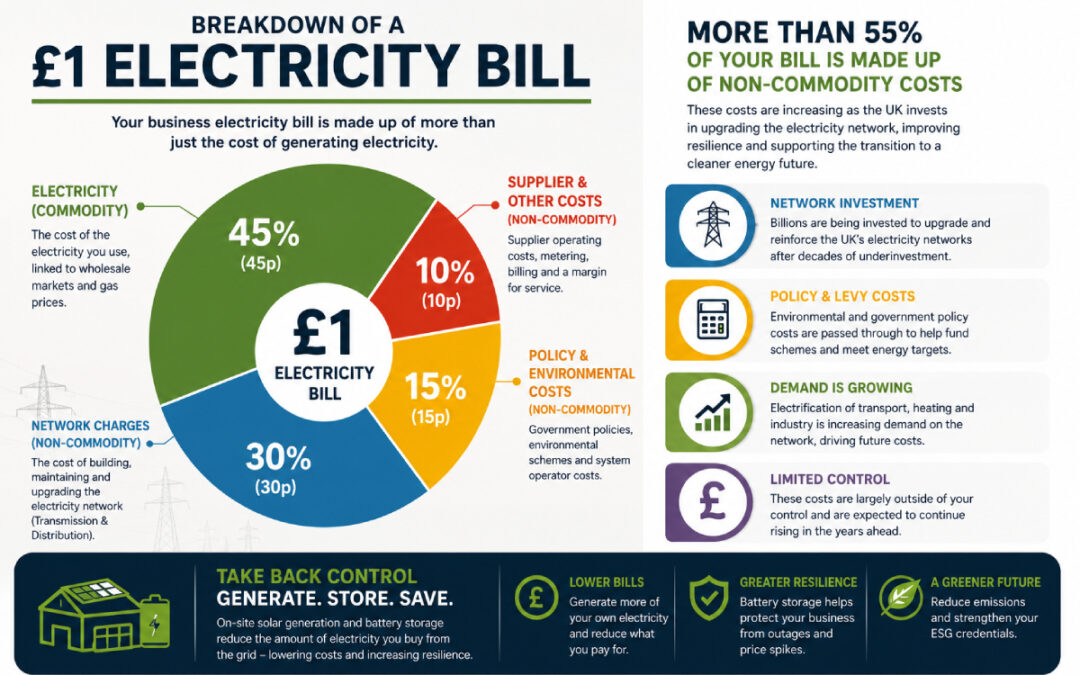
Today’s electricity bill is made up of two distinct elements:
- The electricity you buy (the commodity cost)
- The cost of delivering it to you (non-commodity costs)
It’s this second category that’s becoming the real driver behind rising business energy bills.
You’re Paying for More Than Just Electricity
Every time your business imports electricity from the grid, you’re not simply paying for the power generated. You’re also contributing towards:
- maintaining and upgrading the National Grid
- local Distribution Network Operator (DNO) infrastructure
- balancing the electricity network
- environmental and government policy costs
- system resilience and security
- future energy infrastructure investment
These costs are often grouped together as non-commodity charges and for many UK businesses they now account for more than half of the total electricity bill.
Why Are These Costs Rising?
The answer is actually quite straightforward. The UK’s electricity network is undergoing one of the biggest infrastructure upgrades in its history. Over the coming years, billions of pounds will be invested to support:
- electrification of transport
- heat pumps
- battery storage
- renewable generation
- growing electricity demand
- reinforcement of ageing networks
These investments are essential if the UK is to meet future energy demand but someone has to pay for them. Unfortunately, much of that cost is passed through to electricity consumers via network charges and other non-commodity costs. Ofgem’s next electricity network price control (RIIO-3) is expected to increase transmission investment from April 2026 and businesses are already seeing these future costs reflected in pricing.
The Challenge for Businesses
The difficult reality is that businesses have very little control over these charges.
You can negotiate with suppliers.
You can switch tariffs.
You can fix prices.
…but none of these fundamentally reduces your reliance on the grid and if network charges continue rising, as many analysts expect, they will continue affecting businesses regardless of who supplies their electricity.
The Best Way to Reduce Grid Costs?
Buy Less From the Grid.
It sounds obvious but it’s also incredibly effective. Every unit of electricity your business generates itself is one less unit you need to import. This means you’re reducing exposure not only to wholesale electricity prices, but also many of the associated charges that come with importing electricity. This is where commercial solar becomes far more than a sustainability investment.
It becomes a cost-control strategy.
Energy Independence Starts With Generation
Generating your own electricity gives your business something that’s becoming increasingly valuable:
Control!
Instead of being completely exposed to external price rises, you begin producing a significant proportion of your own energy. This means:
- lower electricity purchases
- reduced exposure to market volatility
- improved cost certainty
- greater operational resilience
…and when solar is combined with battery storage, those benefits become even greater.
Battery Storage Gives You Even More Control
Commercial battery storage allows businesses to store electricity generated during the day and use it later when demand, and often prices, are higher. It also helps businesses:
- reduce peak demand
- avoid expensive import periods
- increase self-consumption of solar energy
- improve resilience during grid interruptions
- prepare for future flexibility markets
Rather than simply consuming electricity, businesses begin actively managing it.
The Cheapest Electricity Is the Electricity You Don’t Need to Buy
Every kilowatt-hour your business generates and uses onsite is one that doesn’t need to travel across the electricity network. This means less exposure to:
- wholesale market volatility
- network charges
- future infrastructure costs
- policy-driven levies
- rising system charges
While some standing and fixed charges remain, reducing imported electricity can significantly reduce a business’s overall energy costs and dependence on future price increases.
Future-Proofing Your Business
Nobody can accurately predict where electricity prices will be in five or ten years but one thing is becoming increasingly clear:
- Electricity demand is rising.
- Network investment is increasing.
- Infrastructure costs are growing.
Businesses that remain entirely dependent on grid electricity will continue to be exposed to those changes. Businesses generating their own energy place themselves in a far stronger position.
Take Back Control with Verdant Future
At Verdant Future, we believe businesses shouldn’t simply accept rising electricity costs as an unavoidable overhead.
By combining commercial solar, battery storage and intelligent system design, we help organisations reduce their dependence on imported electricity and build greater long-term resilience.
The goal isn’t to disconnect from the grid.
It’s to become less dependent on it.
Because the less electricity you need to buy, the less exposed you are to the rising costs that are increasingly beyond your control.