
For decades, electricity has been something businesses simply bought. You connected to the grid, agreed a contract with an energy supplier and paid whatever the market dictated. If prices went up, you absorbed the increase. If the network struggled to meet demand, you waited for the infrastructure to catch up…but that relationship is beginning to change.
Across the UK, businesses and commercial property owners are increasingly looking at ways to generate, store and manage their own electricity rather than relying entirely on energy supplied through the national grid. The concept is increasingly being referred to as Bring Your Own Power (BYOP), and it could have significant implications for owners and occupiers of industrial estates, warehouses and larger commercial premises.
The thinking is relatively simple: if you have the space to generate electricity and the infrastructure to store it, why continue buying more from the grid than you need to?
For industrial and commercial property owners, the opportunity is particularly compelling. Large roof areas, available land and substantial electricity requirements make many of these sites ideally suited to onsite solar generation and battery storage and importantly, this isn’t just about becoming greener. It’s about reducing costs, improving energy security and potentially creating entirely new revenue streams.
What Does Bring Your Own Power Actually Mean?
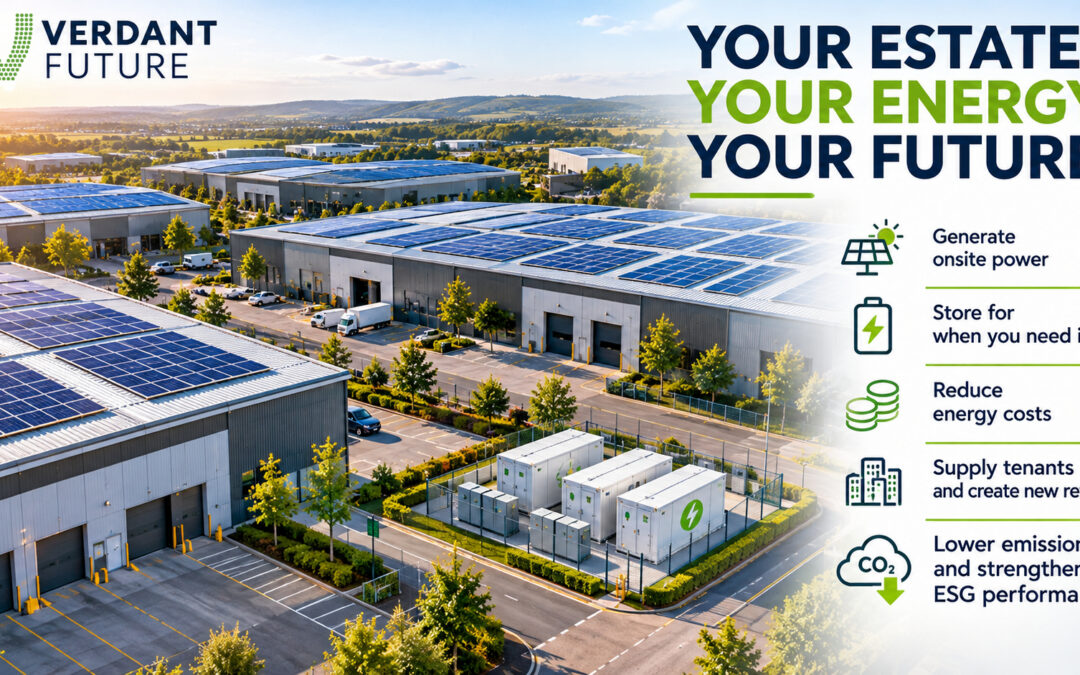
Bring Your Own Power isn’t about disconnecting from the national grid or making your business completely self-sufficient. It’s about taking greater control of where your electricity comes from and how you use it. In practical terms, it means generating electricity onsite, storing any surplus where appropriate and using that energy when your business needs it. For most commercial properties, this involves combining three key elements:
Solar generation: Photovoltaic (PV) panels installed on rooftops, car parks or suitable surrounding land generate electricity directly from sunlight.
Battery storage: Surplus electricity can be stored rather than immediately exported to the grid, making it available later when generation falls or demand increases.
Intelligent energy management: Monitoring and control systems help determine when electricity should be generated, stored, consumed or exported to make the most effective use of the available energy.
Together, these technologies allow businesses to become active participants in their own energy supply rather than simply consumers. This is often referred to as behind-the-meter energy, because generation and storage are connected on the customer side of the electricity meter and can directly serve the property’s energy requirements.
Knight Frank highlighted this growing trend in its September 2026 research, identifying onsite solar and battery storage as increasingly important features of both new developments and existing commercial property estates.
The message is clear: energy is becoming an increasingly important part of property strategy, rather than simply another operating expense.
Why Industrial Estates Are Particularly Well Suited
Not every commercial property has the space or energy requirements to make onsite generation worthwhile. Industrial estates, however, often have a combination of characteristics that make them particularly attractive candidates.
Consider the typical industrial or logistics development. Large warehouse roofs can provide thousands of square metres of available space for solar panels. Manufacturing facilities often have substantial electricity requirements, while distribution centres, refrigeration facilities and other operations can consume significant amounts of power throughout the working day.
In many cases, there is also additional land, parking or surrounding space that could potentially accommodate further energy infrastructure. It is an opportunity that is difficult to ignore.
Research presented by Solar Energy UK to Parliament highlights the scale of the potential. UK Warehousing Association analysis estimates that the largest 20% of UK warehouses alone offer approximately 75 million square metres of roof space, potentially capable of supporting up to 15GW of solar capacity. That’s an enormous amount of electricity generation potential sitting above existing commercial operations.
Not every roof will be suitable. Structural capacity, orientation, shading, electrical infrastructure and grid connection arrangements all need to be considered but for suitable properties, the opportunity is considerable and the benefits aren’t limited to the business occupying the building. For landlords with multiple units or entire industrial estates, onsite generation could become an important part of the overall property strategy.
The Financial Case: Why Generate Your Own Electricity?
One of the biggest attractions of generating electricity onsite is the ability to reduce the amount purchased from an energy supplier. Every unit of electricity generated and consumed onsite is one less unit that needs to be imported from the grid. That can provide protection against fluctuating wholesale electricity prices and reduce exposure to some of the network and other charges associated with imported electricity.
For businesses with substantial and relatively consistent energy requirements, these savings can accumulate over time. There are several ways commercial solar can deliver financial benefits:
Reduce electricity imports – Solar panels generate electricity during daylight hours, helping to meet the building’s existing demand. The more generation that coincides with consumption, the less electricity needs to be purchased.
Improve long-term cost certainty – Generating a proportion of your own electricity reduces dependence on external energy suppliers and provides greater visibility over future energy costs.
Make better use of available space – Large industrial rooftops that would otherwise serve little purpose can become productive assets, generating electricity for the building and potentially supplying other occupiers.
Reduce exposure to rising energy costs – Although businesses will remain connected to the grid and subject to certain fixed charges, reducing imported electricity can help limit exposure to future price increases.
The financial case will vary considerably depending on the size of the installation, electricity consumption, import tariff, export arrangements and the proportion of generated electricity used onsite. This is why understanding a property’s actual energy profile is so important before deciding on system size.
Battery Storage: The Missing Piece of the Puzzle?
Solar generation is naturally dependent on daylight. A warehouse might generate more electricity than it needs during a sunny afternoon, yet still need to purchase electricity later in the evening or during periods of low solar generation. Without storage, surplus electricity may be exported to the grid, often at a lower value than the cost of purchasing electricity back when it is needed. This is where battery storage changes the equation.
By storing surplus solar generation, businesses can make better use of the electricity they produce themselves. For example, a manufacturing facility may generate more solar electricity than it requires during the middle of the day. Rather than exporting all that surplus, a battery can store some of it and release it later when production continues but solar generation has reduced.
Battery storage can also be used to charge during cheaper electricity periods and discharge when import prices are higher, depending on the site’s tariff and operating requirements. For industrial and commercial operations, the potential benefits include:
- Greater use of self-generated solar electricity.
- Reduced reliance on grid imports during expensive periods.
- Better management of peak electricity demand.
- Greater control over energy consumption.
- Potential participation in energy flexibility and grid support services.
Importantly, battery storage needs to be sized and configured around the actual requirements of the site. A larger battery isn’t necessarily a better investment, and the financial returns depend on how frequently and effectively it can be used.
The objective is to make the energy system work harder, not simply install more equipment.
Industrial Estates: An Opportunity for Landlords as Well as Tenants
Perhaps one of the most interesting aspects of the BYOP concept is the opportunity it creates for commercial landlords.
Traditionally, a landlord’s relationship with tenants has centred around providing premises and collecting rent but onsite renewable generation introduces another possibility and that is becoming a provider of electricity as well as property.
Imagine an industrial estate with several warehouse units, each occupied by a different business. A suitably sized solar installation, potentially supported by battery storage, could generate electricity that is used across the estate.
Subject to the necessary electricity supply arrangements, the landlord could potentially sell some of that electricity to tenants at an agreed rate below their alternative supply cost. The benefits are significantly attractive to both parties. Tenants gain access to competitively priced electricity, helping reduce operating costs and exposure to external energy prices. Landlords can generate an additional income stream from electricity that might otherwise have been exported to the grid at a lower rate.
It also creates an opportunity to differentiate the estate from competing properties, particularly when prospective tenants are increasingly considering energy costs and sustainability credentials when choosing premises.
There are, of course, important practical considerations. Electricity resale arrangements need to account for metering, billing, network charges, lease provisions and applicable supply licensing requirements. The commercial structure also needs to establish who owns the electricity and its associated environmental attributes.
What About Grid Capacity and Energy Security?
Another reason businesses are taking a greater interest in onsite generation is the growing importance of electricity availability.
As the UK moves towards greater electrification, demand for electricity is increasing across transport, heating, manufacturing and commercial operations. For some businesses, obtaining sufficient grid capacity to support expansion or new equipment can be a significant challenge.
While onsite solar and battery storage won’t eliminate the need for a grid connection, they can help reduce the amount of electricity a site needs to import at certain times. This can be particularly useful where a business has high daytime consumption or significant short-term peaks in demand.
Battery storage may also help manage the relationship between the site’s electricity demand and the capacity available through its existing connection. However, it is important to distinguish between reducing imported electricity and securing additional grid capacity. Solar and batteries do not automatically overcome a constrained connection or remove the need for DNO approval. Each project needs to be assessed against the site’s electrical infrastructure and operational requirements.
The wider point is that businesses which take a more proactive approach to energy generation and management may be better placed to deal with future electricity requirements.
From Individual Buildings to Whole-Estate Energy Strategies
For owners of multiple commercial properties, the opportunity extends beyond individual rooftop installations. An industrial estate or commercial portfolio could potentially be approached as a coordinated energy project. Rather than assessing each building in isolation, landlords can look at the combined energy requirements, available roof space, electrical infrastructure and opportunities for shared generation and storage.
One building may have substantial solar generation potential but relatively low electricity consumption. Another may have significant demand but limited suitable roof space.
With the right infrastructure and commercial arrangements, there may be opportunities to connect generation and consumption across different parts of an estate. This is where private-wire arrangements and wider behind-the-meter energy strategies can become relevant. Such projects are more complex than a conventional rooftop installation but they could open up opportunities that wouldn’t necessarily be apparent when looking at individual buildings. For larger property owners, this makes a portfolio-wide energy assessment particularly worthwhile.
Is Bring Your Own Power Right for Every Business?
Not necessarily! Although the opportunities are attractive, the economics of onsite generation and storage depend on a number of factors.
The most suitable projects tend to have some combination of:
- Significant electricity consumption.
- Large areas of suitable roof space or available land.
- Energy demand that coincides with solar generation.
- High electricity import costs.
- Suitable electrical infrastructure.
- Long-term ownership or occupancy arrangements.
A warehouse operating predominantly during daylight hours may be particularly well suited to solar generation, while a manufacturing facility with evening or overnight operations may benefit more from combining solar with battery storage. Similarly, a multi-unit industrial estate could offer opportunities for shared generation and energy supply arrangements that wouldn’t be available to a standalone building.
The important thing is to understand the numbers before committing to an investment. A properly conducted feasibility assessment should consider energy consumption, half-hourly usage data, system design, expected generation, battery requirements, grid constraints, installation costs and projected financial returns. Without that groundwork, there is a risk of installing a system that is either too small to deliver meaningful benefits or larger than the site can economically justify.
Making Bring Your Own Power a Reality with Verdant Future
At Verdant Future, we believe the future of commercial energy is about much more than simply installing solar panels.
It’s about helping businesses and property owners take greater control of their energy supply, reduce operating costs and make better use of the assets they already have.
We work with commercial landlords, industrial estate owners and large energy users to develop fully managed solar and battery storage solutions, from initial feasibility through to installation and commissioning.
Our approach covers the entire project lifecycle, including:
- Energy assessments and feasibility studies.
- Commercial solar and battery system design.
- Financial modelling and return on investment forecasting.
- Planning applications and associated approvals.
- DNO applications and grid connection requirements.
- G99 applications and technical certification where applicable.
- Installation, commissioning and final handover.
By managing the entire process through one coordinated team, we help remove much of the complexity associated with commercial renewable energy projects and importantly, we don’t simply look at how much solar can be installed we look at how the energy will actually be used, whether battery storage makes financial sense and how the overall system can deliver the greatest commercial benefit.
For landlords, this could mean turning unused roof space into an energy-generating asset and potentially creating a new revenue stream. For occupiers, it could mean reducing electricity costs and becoming less dependent on the grid. For businesses with multiple sites, it could be the beginning of a much wider energy strategy.
The question for property owners and business leaders is no longer simply how much electricity they need to buy.
It’s how much they could generate themselves, how effectively they could store and use it, and what commercial opportunities that might create.
At Verdant Future, we help businesses answer those questions and turn the potential of onsite generation into practical, financially viable projects.
Your building already occupies the space. Why not make it generate the power?
Get in touch with Verdant Future to explore the potential of commercial solar and battery storage for your property or industrial estate.