
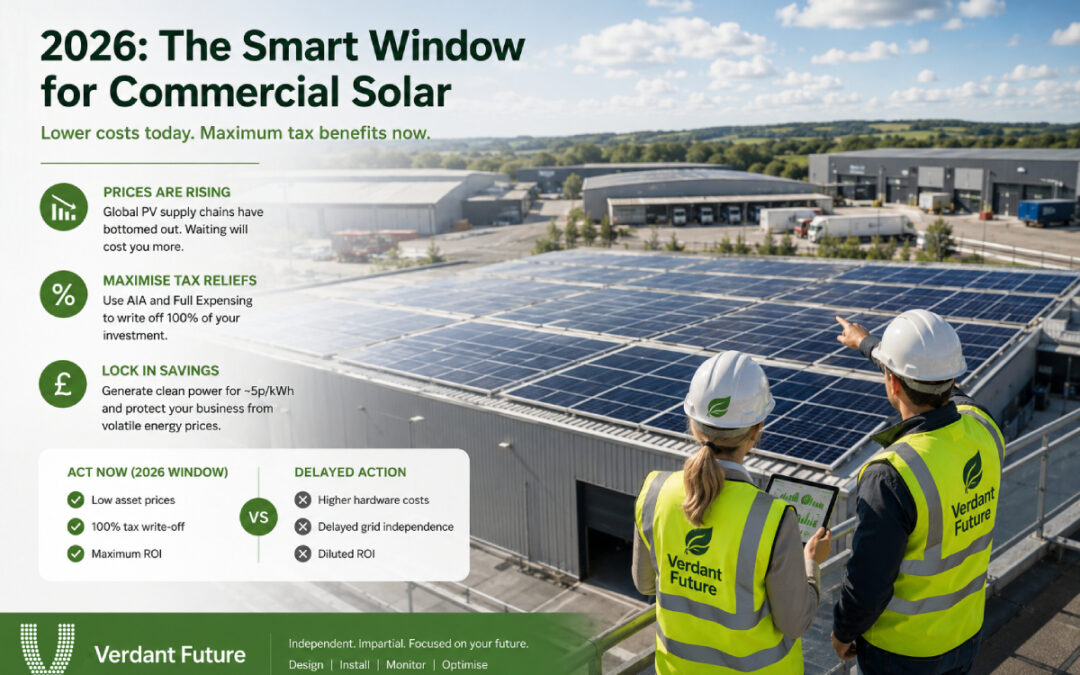
For most financial directors, planning a commercial solar rollout is traditionally viewed through a long-term sustainability lens. However, structural updates to global manufacturing supply chains and the ticking clock on UK corporate tax reliefs have fundamentally shifted the timeline.
If your organisation is looking to protect its bottom line, investing in on-site generation in 2026 is no longer just a green initiative, it is a critical tax and CapEx optimisation window.
The window to maximize your project’s financial return is shrinking due to two simultaneous market forces.
1.Global PV Supply Chains Have Bottomed Out
Over the past decade, solar technology hardware achieved unprecedented cost reductions. However, global market shifts, including changes to international manufacturing export credits, have triggered a baseline price reset.
The era of hyper-deflated solar component costs has ended. For UK businesses, waiting to execute a rooftop or ground-mounted array will not result in cheaper hardware next year; it will almost certainly result in a higher initial asset purchase price.
2.The Power of Full Expensing & Capital Allowances
The UK tax system currently offers powerful mechanisms to heavily subsidise commercial energy projects, but they require timely execution:
- The Annual Investment Allowance (AIA): Allows businesses to deduct 100% of the cost of qualifying plant and machinery, up to £1 million, from their taxable profits in the tax year of installation.
- Full Expensing: For larger corporate entities whose capital expenditure exceeds the AIA threshold, full expensing allows companies to claim a 100% first-year allowance, significantly slashing corporation tax liabilities.
Solar installations, commercial battery storage and associated infrastructure qualify directly for these first-year reliefs. By utilising these tax breaks now, a business can effectively wipe out a massive portion of the upfront project deployment costs.
Learn more about Capital Allowances here
The Reality of Delaying: A Hidden Financial Penalty
When you combine rising equipment costs with the risk of future changes to corporate tax incentives, the financial penalty for waiting is severe.
Consider a standard commercial solar layout. If global hardware prices rise by just 10% to 15%, a business delaying their project into the next financial year faces a compounding loss: higher capital costs, delayed grid-independence and a missed year of immediate corporation tax offsets.
Current 2026 Window: Low Asset Prices + 100% Tax Write-off = Maximum ROI
Delayed Action: Higher Hardware Costs + Delayed Grid Independence = Diluted ROI
Turning Your Roof Space Into a Fixed-Rate Power Plant
With volatile wholesale energy markets continuing to dictate variable grid tariffs (frequently averaging around +25p/kWh), self-generation is the only definitive way to lock in long-term operational certainty.
A turnkey commercial solar array converts empty roof space into an active asset, delivering stabilised electricity at an equivalent long-term cost of roughly 5p/kWh. This hedges your business against unpredictable market spikes for the next 25 to 30 years.
How Verdant Future Removes the Friction
At Verdant Future, we provide completely independent, honest and impartial advice. We have no financial affiliations with specific suppliers or manufacturers; our engineering team designs bespoke systems entirely aligned with your site’s specific energy demand profile.
We manage the entire project lifecycle via our full turnkey delivery framework:
- Detailed demand curve analysis and advanced financial forecasting.
- Complete navigation of planning permissions and complex local grid (DNO) G99 applications.
- Full system engineering, MCS-certified installation, and long-term asset monitoring.
Don’t let your next tax year pass by without optimising your roof space.