
For owners and landlords of commercial and industrial property, sustainability is becoming increasingly difficult to ignore. Rising energy costs, changing tenant expectations, growing pressure to reduce carbon emissions and tightening energy efficiency requirements are all changing the commercial property landscape.
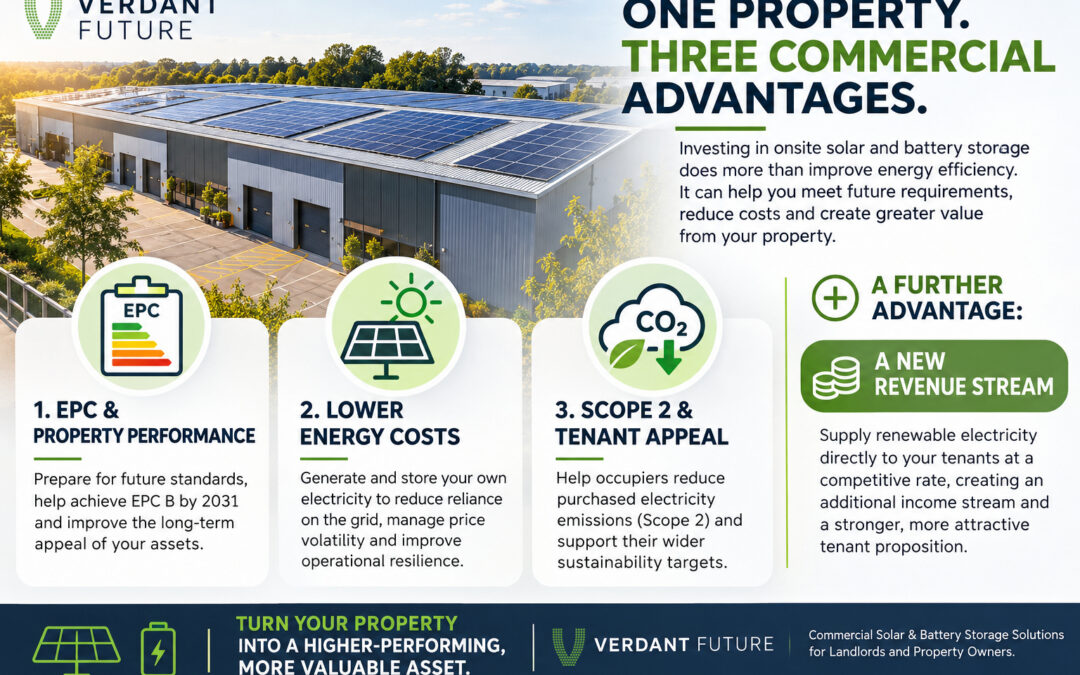
With the Government now confirming its intention to introduce a minimum EPC B requirement for larger privately rented commercial buildings from 2031, the message to landlords is becoming clearer: the energy performance of your property portfolio is going to matter more than ever.However rather than viewing this as another regulatory burden, we believe landlords should look at the bigger opportunity. Improving the energy performance of commercial buildings isn’t simply about achieving an EPC rating, it will also reduce operating costs, improve tenant appeal, support corporate sustainability targets and create more resilient, valuable property assets.
At Verdant Future, we believe there is a genuine commercial opportunity for landlords who take action early.
Additional Revenue Stream: Become the Energy Provider to Your Tenants
Perhaps one of the most attractive opportunities for commercial landlords investing in onsite solar generation is the potential to create an entirely new revenue stream.
Traditionally, a landlord’s income comes primarily from rental payments. But by investing in commercial solar and battery storage, landlords have the opportunity to generate electricity onsite and supply it directly to their tenants. In effect, the landlord becomes an energy provider as well as a property provider.
Rather than simply exporting surplus electricity back to the grid, potentially at a relatively low export rate, landlords can supply that electricity to their tenants at an agreed rate that is below the cost of purchasing electricity from a conventional supplier. This creates a compelling proposition for both parties.
The real opportunity lies in creating a mutually beneficial arrangement: tenants gain access to more competitively priced electricity, while landlords generate additional income from an asset that would otherwise be unused roof space.
For owners of larger industrial estates and multi-occupancy commercial properties, the potential is particularly interesting. A single solar installation could potentially serve multiple tenants, creating an ongoing revenue opportunity across an entire property portfolio.
It can become a new business asset that generates income, improves tenant relationships and delivers a stronger return on investment.
EPC B by 2031: What Do Commercial Landlords Need to Know?
Following its announcement on 18 June 2026, the Government has confirmed its intention to raise Minimum Energy Efficiency Standards (MEES) for larger privately rented non-domestic buildings in England and Wales.
Under the proposed changes:
- From 2031, privately rented commercial buildings exceeding 1,000m² will be expected to achieve an EPC rating of B, where improvements are cost-effective.
- Properties below 1,000m² are expected to remain subject to the existing minimum EPC E requirement.
- The previously proposed interim EPC C milestone for 2027 will no longer be introduced.
- Existing flexibility provisions, including the seven-year payback test and exemptions, are intended to remain.
Importantly, the proposed EPC B requirements will only take effect following the introduction and successful passage of secondary legislation through Parliament.
This is an important development for landlords with substantial industrial estates, warehouses, manufacturing facilities and larger commercial properties.
It provides a clearer indication of the direction of travel and, crucially, an opportunity to start planning improvements rather than waiting until compliance becomes unavoidable.
The Opportunity Goes Beyond EPC Compliance
Let’s be honest few commercial landlords actively want to spend money upgrading properties simply because legislation requires them to.
…however what if those improvements could also deliver a financial return?
Improving a building’s energy performance can bring several commercial benefits:
- Reduced electricity consumption and operating costs.
- Greater tenant appeal through more energy-efficient premises.
- Improved resilience against rising energy prices.
- Reduced exposure to future energy efficiency requirements.
- Stronger sustainability credentials.
- Potential improvements in long-term asset attractiveness and investment appeal.
For landlords this is about more than achieving a particular letter on an Energy Performance Certificate. It’s about ensuring properties remain competitive, commercially attractive and fit for the future.
Scope 2 Emissions: Another Reason Tenants Want More Sustainable Buildings
One area that is becoming increasingly important, particularly for larger commercial occupiers, is Scope 2 carbon emissions but what exactly does this mean, and why should landlords care?
Businesses are increasingly measuring and reporting their carbon footprint as part of their environmental, social and governance (ESG) commitments and wider sustainability strategies.
Under the internationally recognised Greenhouse Gas (GHG) Protocol, business emissions are divided into three categories:
Scope 1 – Direct emissions
Emissions generated directly by sources a business owns or controls, such as fuel burned in company-owned boilers or vehicles.
Scope 2 – Purchased energy emissions
Indirect emissions associated with purchased or acquired electricity, heating, cooling and steam consumed by a business.
Scope 3 – Other indirect emissions
All other indirect emissions throughout a company’s value chain, including purchased goods, transport, business travel and certain leased assets.
For many industrial and commercial businesses, purchased electricity represents a significant part of their Scope 2 emissions. This is where the energy performance of the buildings they occupy becomes particularly relevant.
Why Should Landlords Care About Their Tenants’ Scope 2 Emissions?
Increasingly, businesses are looking beyond their own operations when assessing their environmental performance.
A manufacturer, logistics operator or distribution business may have ambitious carbon reduction targets, but if it occupies a large, energy-intensive building that relies heavily on grid electricity, achieving those targets become more challenging.
Landlords who can offer more energy-efficient premises, supported by onsite renewable generation and battery storage, can help tenants address this challenge. This creates a further competitive advantage.
A property that helps an occupier reduce electricity costs and make progress towards its carbon reduction targets could be considerably more attractive than an otherwise comparable building without those capabilities.
It’s worth noting that Scope 2 reporting depends on who purchases or controls the electricity and the relevant lease arrangements. Onsite renewable electricity can reduce reliance on grid electricity and associated emissions, but the precise carbon reporting benefit depends on the accounting method and ownership of the renewable energy attributes.
In other words, sustainability improvements can benefit both sides of the landlord-tenant relationship, even though their carbon reporting responsibilities may differ.
Why Battery Storage Makes the Proposition Even More Attractive
While commercial solar provides the opportunity to generate electricity, battery storage allows that electricity to be used more intelligently.
Without storage, surplus solar generation may need to be exported to the grid, potentially at a lower value than the cost of buying electricity back later.
A commercial battery can capture surplus generation and make it available when the building needs it. This can help:
- Increase onsite consumption of solar electricity.
- Reduce reliance on imported grid electricity.
- Manage peak electricity demand.
- Improve protection against electricity price volatility.
- Support greater energy resilience.
- Potentially access additional revenue opportunities through energy flexibility services.
For landlords, battery storage can also form part of a wider energy infrastructure investment, particularly across larger industrial estates where multiple buildings and occupiers may have complementary energy requirements.
The result is a more sophisticated energy proposition that goes beyond simply installing solar panels.
A More Attractive Proposition for Commercial Tenants
Commercial tenants are increasingly conscious of the costs and environmental impact of operating their businesses.
Energy expenditure can be a substantial overhead, particularly for manufacturers, logistics operators, cold storage facilities and other energy-intensive businesses.
At the same time, many larger organisations are facing increasing pressure from customers, investors and supply chains to demonstrate measurable progress towards carbon reduction targets.
Consequently, the buildings they occupy can play an important role in their wider sustainability strategies. Imagine being able to offer prospective tenants a property that combines:
- Improved energy efficiency.
- Onsite renewable electricity generation.
- Battery storage.
- Reduced exposure to grid electricity costs.
- Infrastructure that supports carbon reduction objectives.
That is a much stronger commercial proposition than simply offering four walls and a roof. For landlords, this could help differentiate properties, strengthen tenant relationships and improve the long-term appeal of their portfolios.
Why Waiting Until 2031 Could Be a Missed Opportunity
Although 2031 may seem some distance away, planning and delivering commercial energy improvements can take considerable time.
Large-scale solar and battery storage projects involve much more than installation. They can require feasibility studies, system design, structural assessments, planning applications, Distribution Network Operator (DNO) applications, grid approvals and certification.
There may also be practical considerations around existing leases, tenant operations, roof condition and available electrical capacity.
For landlords with multiple properties, these considerations become even more significant. Starting early provides an opportunity to:
- Assess the current performance of individual buildings.
- Identify properties requiring the greatest attention.
- Develop a phased investment strategy.
- Coordinate improvements with planned maintenance and refurbishment.
- Evaluate financial returns before committing capital.
- Explore opportunities to combine EPC improvements with renewable energy investment.
The objective should not simply be to meet a deadline. It should be to make commercially sensible improvements that deliver benefits over many years.
How Verdant Future Helps Commercial Landlords Turn Compliance into Opportunity
At Verdant Future, we work with commercial property owners, landlords and businesses to develop renewable energy solutions that make commercial and financial sense.
We understand that investing in commercial solar and battery storage is about far more than choosing equipment and arranging an installation.
It requires careful consideration of the building, its energy requirements, the available infrastructure, regulatory considerations and the financial return. That’s why we provide a fully managed, end-to-end service.
Our support includes:
- Energy assessments and feasibility: Understanding existing energy consumption and identifying opportunities across individual properties or entire portfolios.
- Commercial solar design: Developing systems around building characteristics, energy requirements and available roof space.
- Battery storage modelling: Assessing the potential benefits of storage, including increased solar self-consumption and peak demand management.
- Planning applications: Managing the relevant planning considerations and applications.
- DNO applications and grid approvals: Coordinating the technical requirements and connection approvals.
- Installation and commissioning: Managing the delivery, testing, certification and final handover.
Rather than leaving landlords to coordinate multiple contractors, consultants and specialists, we provide one point of contact and a coordinated approach throughout the project.
We also look beyond the immediate installation to consider the wider commercial benefits, helping clients understand how renewable energy infrastructure can support their longer-term property and energy strategies.
Don’t Just Future-Proof Your Properties. Make Them Work Harder.
The introduction of higher energy efficiency expectations presents a challenge for commercial landlords, but it also creates an opportunity.
Properties that are more energy efficient, less dependent on grid electricity and better equipped to support tenants’ sustainability objectives are likely to have a stronger proposition in an increasingly competitive commercial property market and while legislation may be the catalyst for change, the real benefits can extend much further.
Lower energy costs. Greater resilience. Improved tenant appeal. Reduced carbon emissions. Stronger long-term asset performance.
At Verdant Future, we believe sustainability should make commercial sense.
If you own or manage industrial estates, warehouses or larger commercial property portfolios, now is an excellent time to understand what improvements could be made and what the potential returns might look like.
Let’s turn your property portfolio into a more energy-efficient, resilient and commercially valuable asset.
Talk to Verdant Future about a commercial energy assessment and discover what’s possible.