
When people think about battery storage, they almost always assume one thing: you need solar panels first.
But that assumption isn’t always true.
While batteries are a natural partner to solar installations, they are increasingly being deployed as standalone energy management tools by businesses looking to control costs, improve resilience and operate more intelligently in a volatile energy market.
In fact, modern battery storage systems can deliver significant benefits even without on-site renewable generation.
For many organisations, battery storage is becoming a strategic energy asset in its own right.
Turning Energy Price Volatility Into an Opportunity
Electricity pricing in the UK is increasingly dynamic. Many suppliers now offer time-of-use tariffs, where electricity prices fluctuate throughout the day depending on demand and wholesale market conditions.
Battery storage allows businesses to take advantage of this.
Instead of buying electricity when prices are highest, a battery can charge when energy is cheapest and discharge when tariffs rise, effectively smoothing out those peaks in pricing.
For example, off-peak electricity rates overnight can sometimes be a fraction of peak daytime prices. By storing that cheaper energy and using it later, businesses can significantly reduce their effective cost per kWh.
This process, often called energy arbitrage, turns market volatility from a risk into a financial opportunity.
Reducing Peak Demand Charges
For larger commercial energy users, electricity costs are not just about total consumption.
Many tariffs also include maximum demand charges, based on the highest level of electricity drawn from the grid during a specific period.
Battery storage can help manage this.
By discharging during moments of high demand, batteries can reduce the peak load your facility places on the grid, which in turn lowers those costly demand charges.
For energy-intensive businesses, this can represent a meaningful reduction in overall electricity expenditure.
Protection Against Power Outages
Another increasingly valuable benefit of battery storage is resilience.
Unexpected power interruptions can have serious consequences for businesses:
- Production downtime
- Data loss
- Damaged equipment
- Operational disruption
Battery systems can provide instant backup power, allowing critical operations to continue running during grid outages or until backup generators activate.
For organisations where continuity matters, from logistics centres to manufacturing facilities, this capability alone can justify the investment.
Smarter Energy Management
Modern battery systems are far more sophisticated than simple storage devices.
Advanced monitoring platforms allow businesses to:
- Track energy usage in real time
- Analyse consumption patterns
- Automate charging and discharging based on tariff signals
- Optimise energy purchasing strategies
In effect, the battery becomes part of a smart energy management system, helping businesses operate more efficiently and strategically.
Future-Proofing Your Energy Strategy
Battery storage also prepares organisations for the next phase of the energy transition.
Electricity markets are moving toward:
- Dynamic pricing
- Increasing renewable generation
- Electrification of transport and heating
- Greater grid flexibility requirements
Businesses with battery storage in place are far better positioned to adapt to these changes and take advantage of emerging opportunities in the energy market.
Of course, if you later choose to install solar generation, your battery system can easily integrate to store and optimise that energy.
Supporting the Growth of Electric Vehicle Infrastructure
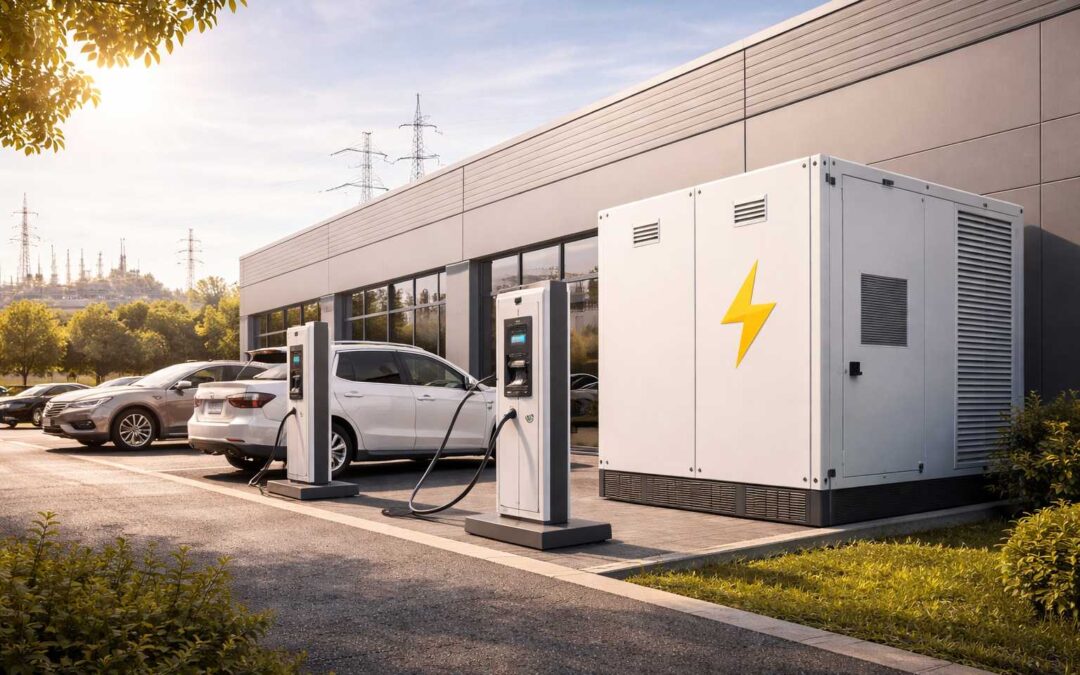
Battery storage can also play an important role in supporting electric vehicle charging infrastructure.
As more businesses introduce EV fleets or install charging facilities for staff and customers, electricity demand on-site can increase significantly. Rapid charging in particular can place sudden peaks on a building’s power demand.
Battery systems help manage this by:
- Supplying stored electricity during high-demand charging periods
- Reducing strain on the grid connection
- Avoiding expensive grid upgrades
- Supporting smarter charging strategies
In effect, battery storage acts as a buffer between your EV infrastructure and the grid, helping organisations expand their electrification plans without dramatically increasing energy costs or peak demand charges.
For businesses planning the transition to electric transport, battery storage can therefore become a critical enabling technology.
A Faster Route to Energy Efficiency
Another often overlooked advantage of standalone battery storage is the speed at which it can be deployed compared with larger renewable installations.
While solar generation delivers tremendous long-term value, projects that combine solar and battery storage can sometimes involve longer planning timelines, structural considerations and more complex grid connection approvals.
Battery storage on its own can often be implemented more quickly.
In many cases, businesses can begin with a battery system and the necessary Distribution Network Operator (DNO) applications first. These systems typically require less physical infrastructure than a full solar installation, the approval and deployment process can be significantly faster.
This approach allows organisations to start benefiting from energy cost optimisation, demand management, and resilience improvements sooner, while still leaving the door open to integrate solar generation later as part of a wider energy strategy.
In Summary
Battery storage is often viewed as the companion to solar but as we’ve seen, it is increasingly proving to be a powerful solution in its own right.
Even without on-site generation, battery systems can help businesses take greater control of their energy usage, reduce exposure to volatile pricing, improve operational resilience, and prepare for the growing electrification of transport and infrastructure.
They can also be implemented more quickly than larger renewable projects, allowing organisations to begin capturing efficiencies sooner while laying the groundwork for future solar integration.
Whether deployed as a standalone system or as part of a broader renewable energy strategy, the benefits are clear.
Solar installations remain one of the most powerful tools for reducing energy costs and carbon emissions.
Battery storage is no longer simply an accessory to solar.
It is a standalone technology capable of delivering meaningful financial and operational benefits, including:
- Energy price arbitrage
- Demand charge reduction
- Backup power and resilience
- Improved energy management
- Supporting EV infrastructure
- Reduced exposure to volatile energy markets
Take Control of Your Energy Strategy
If your organisation is looking for ways to reduce costs, increase resilience and take greater control over its energy usage, battery storage may be the solution, even without on-site generation.
At Verdant Future, we design and deliver commercial battery storage systems tailored to the operational and financial needs of each client.
If you’d like to explore how battery storage could work for your business, get in touch with our team today.